|
Strategic Landscape Reserve Designs (SLRDs)
In order to implement EBM legal requirements and monitor progress landscape scale reserve designs have been completed for much of the region. CFCI businesses with forest operations in the region have completed 70 of these designs producing maps of large landscapes delineating old growth forest reserves and habitat reserves for focal wildlife species.
The SLRDs provide spatial guidance for forest planners as they determine where forest stands will be reserved to meet riparian, focal species and old growth representation requirements, and which stands where harvesting will occur.
Example SLRD map 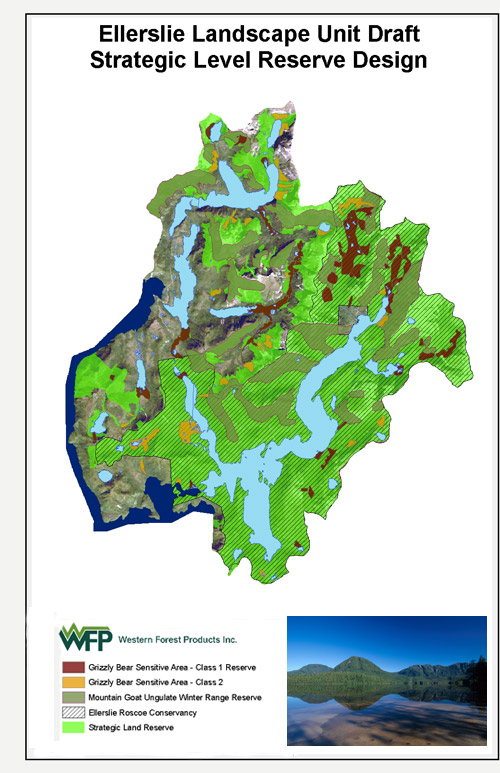
Above the Line
In 2011 the Joint Solutions Project began an adaptive management exploration of ways to concurrently achieve low ecological risk across the Great Bear Rainforest while minimizing the impact on the woodflow that supports commercial forestry's contribution to human wellbeing. The Above the Line project was completed in 2014. Project outcomes provided spatial recommendations for achieving low ecological risk outcomes and support for human well-being. In 2015 JSP presented the recommendations to the Province and First Nations for their consideration.
Focal Species
The EBM Handbook defines a focal species as "Species that warrant special protection and stewardship. As such, they help determine area for protection and stewardship actions to sustain and improve known populations." For the Great Bear Rainforest specialists identified five focal species:
- Grizzly bear
- Northern goshawk
- Marbled murrelet
- Mountain goat
- Tailed frog
In 2010 a series of expert workshops were held for the purpose of establishing habitat thresholds (high risk and low risk) for each species. The information provided by the expert workshops is being used to guide planning and development activities to avoid high-risk situations (insufficient habitat) and ensure the viability and persistence of each species. A conservation gap assessment completed in 2011 using the results of the expert workshops indicates that none of the focal species is currently at high risk.
|